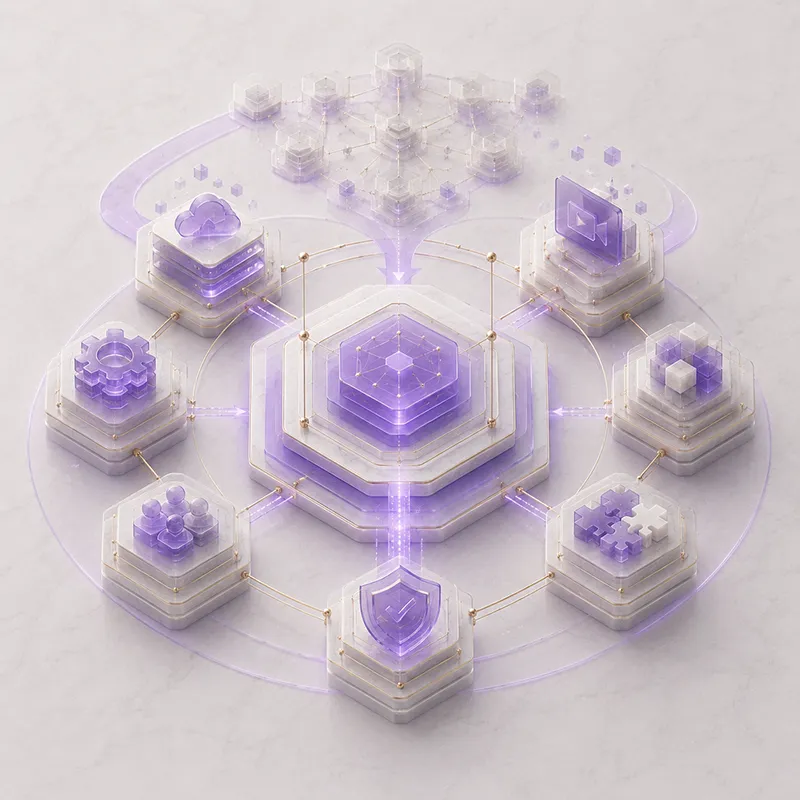

Anonymized case · Modernization and applied AI strategy
Replacing a big-bang transformation with a modular modernization path.
A long-established German healthcare company faced a familiar transformation choice: replace a stable but ageing enterprise environment with one expensive standard platform, or continue making minor adjustments around increasingly brittle workflows. Neoground identified a third path — retain the sound data and operating foundations, redesign the work in deliberate slices, and establish a secure AI layer capable of supporting future automation.
- Client
- German healthcare-sector enterprise with approximately 600 employees
- Engagement
- Modernization review and AI initiative review
- Leadership
- CEO and CTO sponsorship
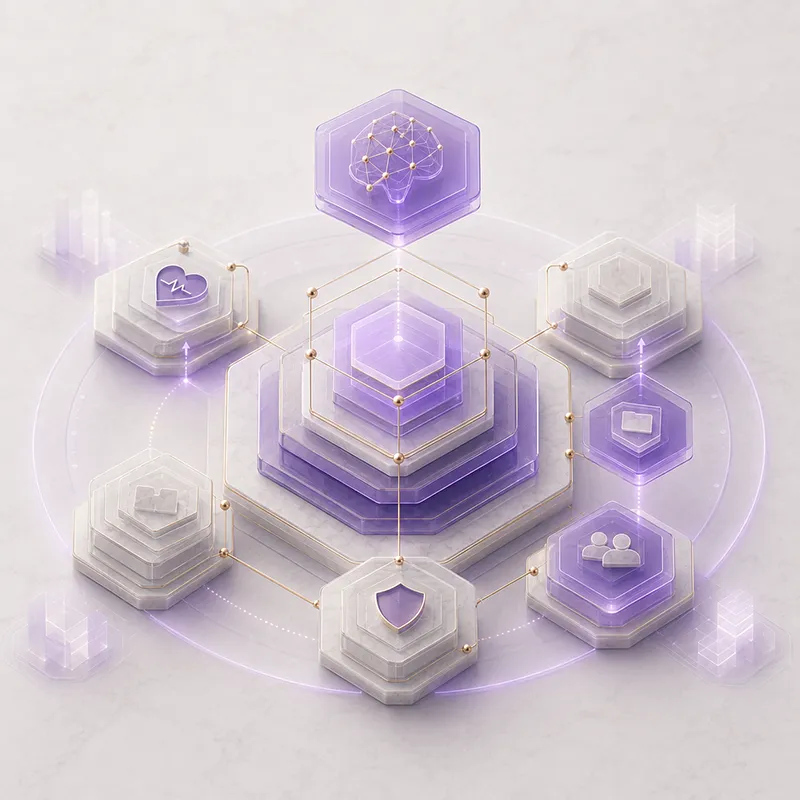
Stable data structures and valuable business logic remained in place rather than being replaced indiscriminately.
Workflows, software areas, integrations, and data components could be modernized in controlled slices.
Sensitive data could be transformed internally before approved use with more capable external AI services.
Navigate this case study
Context
A stable enterprise environment was carrying workflows designed for another era.
The client was a long-established German company operating in the healthcare sector. Its work involved financial administration, large volumes of documents, and substantial case-based processing performed by specialist employees.
The organization had modernized its technology several times over the preceding decades. Its current environment had been operating for more than 20 years and followed a conventional enterprise model built around Windows, Microsoft SQL Server, proprietary software, and custom internal applications.
The age of that stack was not itself the central problem. The environment remained stable and contained valuable business logic, data structures, and operational knowledge.
The apparent choice
Leadership was being offered disruption or stagnation.
One option was to purchase a large industry-specific enterprise platform and reorganize the company around its standard processes. This promised consolidation, but required significant investment, long implementation cycles, extensive migration, and substantial operational disruption.
The alternative was to retain the current environment and continue making limited adjustments. That reduced immediate risk, but preserved workflows that were already becoming slower to change and increasingly difficult to extend.
Neither choice addressed the central question: how the company could establish a foundation for the next generation of workflow automation, data use, and applied AI without discarding the parts of the business system that still worked well.
- A full standard-platform replacement would be expensive and disruptive.
- Minor maintenance would preserve increasingly brittle process structures.
- A generic industry solution could reduce the company's ability to differentiate its operations.
- Existing custom software already encoded valuable domain-specific working knowledge.
- Future AI initiatives depended on better workflow, data, and integration boundaries.
Modernization review
Separate ageing technology from outdated work before deciding what to replace.
Neoground reviewed the operating model across employee workflows, internal applications, databases, integrations, document handling, and group-specific working practices.
The assessment showed that the underlying data structure was sufficiently sound to remain a foundation. It could be extended and adjusted where required without forcing an immediate company-wide migration.
The larger opportunity was in the interaction between people, workflows, and software. Many employees still performed sequences inherited from paper-based administration, except that PDFs, digital forms, and application windows had replaced physical files.
This changed the modernization question from which platform to buy into which operating capabilities should be improved first, what foundation could be retained, and how each intervention could prepare the next.
Workflow analysis
Similar work was being performed through different local systems and habits.
The review found that organizational groups often handled comparable cases in different ways. Some teams had developed effective local practices, while others required more steps or relied on additional manual coordination.
Shared spreadsheets, group-specific lists, and informal intermediate records had grown around the official systems. These tools solved immediate needs but also fragmented process knowledge and made performance difficult to compare.
Neoground mapped representative employee journeys and separated essential professional judgment from repeated administrative handling. This made it possible to identify where workflows could be simplified, standardized, supported by better software, or automated.
- Comparable tasks were completed differently across teams.
- Local spreadsheets contained process and case information outside central systems.
- Repeated document handling and data transfer consumed specialist employee time.
- Faster local practices were not consistently transferred across the organization.
- Workflow variation made future automation harder to design and govern.
- Process improvement required both shared principles and room for legitimate domain differences.
Modular modernization
Retain the coherent core and create boundaries that allow controlled change.
Neoground proposed a modular intervention model around three distinct layers: employee-facing workflows and applications, the underlying data foundation, and the wider network of tools, platforms, and integrations.
The principal internal application could remain relatively consolidated because employees needed access to a broad set of related case and document information in one place. A purely distributed microservice interface would have fragmented the user experience without creating equivalent operational value.
Internally, however, the system could still adopt modular service boundaries. Individual workflows, application sections, integration components, and database areas could be changed independently while remaining part of one coherent employee environment.
-
01
Retain the data foundation
Preserve the sound existing structures and improve them selectively rather than forcing an unnecessary wholesale migration.
-
02
Map employee journeys
Understand how documents, decisions, and case information move through real work before redesigning software.
-
03
Modularize the internal application
Keep a coherent employee-facing workspace while separating capabilities sufficiently for incremental improvement.
-
04
Define integration boundaries
Connect proprietary tools, custom applications, document systems, and future services through clearer interfaces.
-
05
Improve one workflow at a time
Deliver measurable operational changes without requiring the organization to absorb one disruptive transformation.
-
06
Prepare for future capabilities
Make workflow, data, and application boundaries suitable for automation and expanding AI functionality.
AI initiative review
The company had AI ideas, but not yet one AI capability.
AI had entered the organization through general employee tools and loosely defined ideas around document extraction, transformation, and assistance. Adoption remained limited because these tools sat beside established work rather than inside it.
Employees were expected to identify use cases, reconstruct context manually, and decide how AI output should fit into existing processes. This made AI feel peripheral and placed the burden of integration on individual users.
The review showed that the organization did not primarily need more isolated assistants or experiments. It needed a reusable operating layer that could connect approved AI capabilities to real data, workflows, applications, controls, and human review.
Secure AI architecture
Separate sensitive identity from the intelligence applied to the work.
Healthcare-related and financial information required strict control. Sending raw case documents or customer data indiscriminately to external AI services was not an acceptable foundation.
Neoground designed an internal AI and data-protection layer capable of processing sensitive information inside the controlled environment. Identifying or protected data could be transformed, masked, or replaced before selected tasks were passed to more capable external models.
Results could then be returned to the protected environment and reconnected with the authoritative case context. To employees, the AI-assisted workflow could still operate on the real case. The privacy boundary remained embedded in the architecture rather than depending on each user to remove sensitive information manually.
- Internal processing of sensitive source material
- Automated detection and transformation of protected data
- Controlled use of external AI on anonymized or substituted context
- Reconnection of approved results with the authoritative internal record
- Reusable access for chat, extraction, classification, transformation, and background tasks
- Central policies rather than employee-by-employee privacy decisions
Human-in-the-loop operation
Automation could increase progressively without transferring accountability blindly.
The architecture supported both visible employee assistance and background AI tasks. Documents could be classified, information extracted, text transformed, or proposed case data prepared before an employee began the next step.
Human review remained part of the workflow wherever ambiguity, professional responsibility, or quality requirements justified it. Corrections and approvals could also provide evidence for improving prompts, models, rules, and future automation levels.
As AI capabilities improved, the same operating layer could take responsibility for larger portions of a task without rebuilding the privacy, integration, and governance model for every new use case.
The strategic judgment
Modernization did not require choosing between preserving everything and replacing everything.
A generic enterprise suite could have modernized the visible technology while forcing the organization to conform to another provider's operating assumptions. Continuing with isolated adjustments would have preserved flexibility, but without creating the structure required for wider transformation.
Neoground identified a more deliberate path: retain the stable data and domain foundations, improve employee workflows through custom software, modularize the application and integration landscape, and establish one secure AI capability that could serve many use cases.
This approach preserved operational continuity and differentiated business knowledge while creating clearer paths for future change.
The company did not need one new system to replace the old world. It needed an architecture in which each valuable part could evolve without holding the rest in place.
Outcome
A broad replacement debate became a sequenced modernization and AI programme.
Leadership gained a clearer view of which parts of the existing environment remained valuable, which workflows created the greatest friction, and where modular interventions could produce progress without a company-wide migration.
The recommended architecture preserved a coherent employee workspace while allowing database areas, workflows, integrations, and application capabilities to be improved in controlled slices.
Process variation and local spreadsheet-based practices were made visible as organizational concerns rather than treated only as software defects. This created a basis for improving workflows before automating them.
The AI initiative also moved beyond disconnected tools. The company gained a secure capability model through which internal and external AI could support document processing, data extraction, transformation, employee assistance, and future background automation while maintaining control over sensitive information.
No formal company-wide productivity attribution was available. The engagement instead established the technical and operating conditions through which workflow efficiency and automation could increase progressively.
- Stable data and domain foundations were retained.
- A disruptive standard-platform replacement was no longer treated as the only modernization path.
- Employee journeys and workflow variation became explicit transformation inputs.
- Internal software could evolve through modular, sequenced interventions.
- Group-specific spreadsheets and fragmented process records were identified for consolidation.
- AI use cases gained one secure and reusable operating layer.
- Sensitive data could remain protected while approved external AI capabilities were used.
- Human review and correction remained part of quality-sensitive workflows.
Leadership could modernize valuable slices of the operating model without replacing every stable component.
Employee journeys and process differences became the basis for application and automation decisions.
Secure data handling, AI access, integrations, and human review could support many future use cases.
Confidentiality note
Why this case remains anonymized.
The engagement involved healthcare-related processing, financial workflows, sensitive enterprise architecture, internal operating practices, transformation plans, and the handling of protected data. The company, specialist processes, software products, and implementation details are therefore not identified.
The client did not commission or approve this public case study, and no testimonial or endorsement is implied. The described findings and architecture reflect the actual engagement, while commercially and operationally sensitive details have been generalized.