
Systems we build · Web Applications

Build the software your company actually needs.

Neoground designs and develops web-based software for customers, teams, and new ventures — from focused internal applications to business software and SaaS products with their own data, workflows, and operating logic.

Purpose-built scope Founder-led delivery Custom pricing Strategy through operation
A complete product system

Product thinking, workflows, data models, architecture, interfaces, infrastructure, and ongoing operation can remain connected under one senior technical direction.

When custom software becomes the right move

The company has outgrown the tools around the work.

A web application becomes valuable when the operating model, customer experience, or product thesis no longer fits inside generic software without increasing friction somewhere else.

01

The workflow is spread across spreadsheets, inboxes, and memory.

Important state lives in several tools, handoffs depend on individual knowledge, and every exception creates another manual process.

What the application can change

Create one explicit workflow, one shared state, and one place where work can continue reliably.

02

The product idea is real, but the prototype cannot carry production.

The first version proved demand or internal usefulness, while architecture, permissions, data quality, billing, observability, and support remain incomplete.

What the application can change

Turn the validated idea into an owned product foundation capable of real customers and continuous development.

03

Existing software forces the company to work around its own process.

Teams adapt decisions, terminology, and customer handling to somebody else’s product model because the important differences cannot be represented.

What the application can change

Model the company’s actual entities, rules, roles, and decisions instead of flattening them into a generic tool.

04

Several systems contain parts of the answer, but none carries the whole operation.

Customer data, transactions, documents, communication, and reporting are present, yet the company still reconstructs context manually.

What the application can change

Connect the relevant systems through one application layer, clear ownership, and a dependable source of truth.

What Neoground can build

Applications shaped around users, data, and the operation behind them.

The engagement can begin with a new product, an internal capability, or a defined workflow. Neoground determines the smallest coherent system that can create durable value.

Customer software

SaaS and digital products

Subscription products, specialist applications, self-service software, and new digital businesses with an independent roadmap.

  • Accounts, roles, billing, and entitlements
  • Product workflows and domain logic
  • APIs, integrations, and background processing

Business software

Operational applications

Web applications that coordinate business processes, information, decisions, and collaboration across teams.

  • Custom data and workflow models
  • Dashboards, queues, approvals, and reporting
  • Permissions and auditability

Connected systems

Portals and application layers

A coherent experience over existing services, databases, vendors, and APIs without forcing every capability into one monolith.

  • Customer and partner portals
  • Integration and orchestration layers
  • Migration paths from fragmented tools

Product foundations

Architecture built for iteration

A maintainable technical base for a product that must evolve through evidence, customer use, and new operating requirements.

  • Neoground PHP and neopren foundations
  • Purpose-built data models
  • Deployment, monitoring, and operating continuity

How the system comes together

The interface is only one layer of the product.

Useful web software joins product direction, interaction, business rules, data, integrations, and operation into one system that can be understood and changed.

A tailored application starts with the shape of the work — not with a stack or a catalogue of features.

Neoground maps the users, entities, states, decisions, exceptions, and surrounding systems before the implementation is allowed to harden around incomplete assumptions.

The resulting architecture remains proportionate: enough structure for reliability and evolution, without turning a focused product into an oversized engineering program.

  • One product model across interface, application, and data
  • Progressive delivery around the highest-value workflow
  • Ownership of architecture and operating consequences
  • Clear extension points for future features and integrations
  • Documentation and observability treated as product work

Web application case study

Rebuilding an online fitness studio as one coherent web application.

An established fitness business depended on undocumented legacy software, fragmented member areas, and labour-intensive administrative processes. Neoground reconstructed the existing system, migrated more than 80,000 users, and rebuilt the service around one maintainable application model.

Illustration
Established online fitness business 80,000+ existing user accounts Undocumented VBS and legacy PHP

Neoground rebuilt the application around the real journeys of members and operators: registration, subscriptions, fitness content, progress tracking, live participation, community interaction, and internal management became connected workflows within one coherent product system.

Users migrated 80k+

Existing accounts and business-critical records transferred into the rebuilt application.

Paying subscriptions

Paid memberships tripled during the wider product and application engagement.

Membership cancellations 20% lower

A clearer, more engaging product experience contributed to materially stronger retention.

01

Reverse-engineered undocumented application behaviour, data structures, and business rules.

02

Rebuilt registration, authentication, subscriptions, content access, and member workflows.

03

Unified formerly separate customer-facing and administrative application areas.

04

Automated recurring management tasks and simplified common operational processes.

05

Extended the application with tracking, profile analysis, livestreaming, messaging, and community features.

View the case study

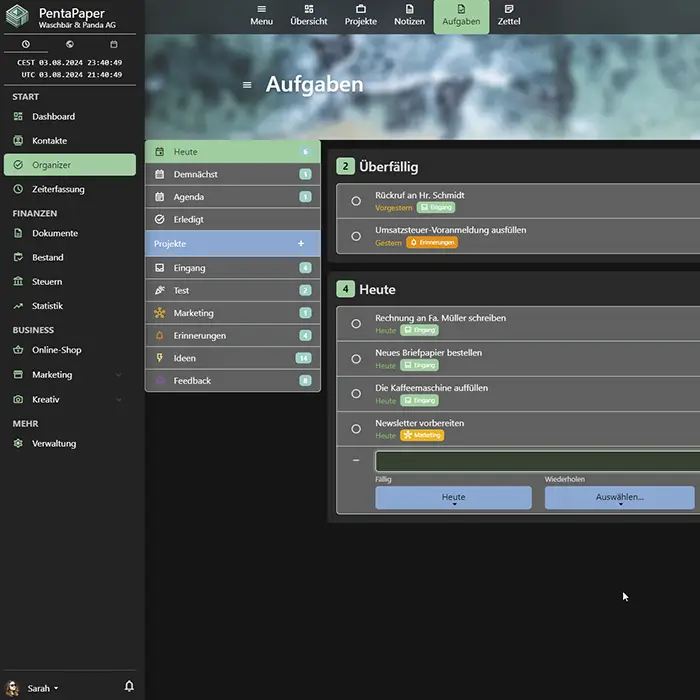
Product proof · PentaPaper

Neoground also carries its own SaaS from product idea into operation.

PentaPaper demonstrates the same connected responsibility applied to an independent Neoground product.

The product requires more than implementation: positioning, user workflow, data, interface, architecture, infrastructure, maintenance, and roadmap decisions must continue to reinforce one another.

That product ownership informs client work. Neoground understands the consequences that arrive after the first successful demo and after the first release.

01

Owned product model

The software follows a coherent user and domain model rather than a sequence of disconnected requests.

02

Independent roadmap

Operating evidence, product direction, and technical architecture shape what is built next.

03

Full operating responsibility

Application, infrastructure, deployment, maintenance, and support remain connected.

04

Reusable foundations

The same technical discipline strengthens future Neoground products and client systems.

Visit PentaPaper
Product interface for Neoground SaaS PentaPaper
PentaPaper Independent SaaS · product and operation

Delivery

Move from uncertainty to a working product without losing the model.

The process stays direct and senior-led. It can fit an early product, an established company, or a team that needs Neoground to take substantial responsibility.

  1. 01

    Frame

    Understand the job the system must perform

    Clarify users, operating value, constraints, current tools, and the decisions the application must support.

  2. 02

    Model

    Design the product and domain together

    Map workflows, entities, permissions, states, interfaces, integrations, and the smallest coherent first release.

  3. 03

    Build

    Deliver a real vertical system

    Implement product experience, application logic, data, and infrastructure in connected increments that can be reviewed and used.

  4. 04

    Operate

    Learn from the running product

    Release, observe, maintain, and continue development with the architecture and product direction still aligned.

Communication

Work can remain highly asynchronous with concise written decisions and demonstrable progress, or integrate into the client’s preferred calls, Slack channels, and delivery routines.

Start with the operating need

Build the application around the company you are becoming.

Share the product idea, difficult workflow, existing system, or growth constraint. Neoground will help define the smallest serious engagement capable of moving it forward.