

Systems we improve · Modernization and Rebuilds

Carry the value forward. Replace the limits.

Neoground helps companies understand, stabilize, modernize, or rebuild software that has become difficult to maintain — with particular depth in PHP, Linux, web applications, and LAMP-like environments.

Assessment through rebuild PHP and Linux depth Progressive transition Custom implementation
Respect the system that carried the business

Long-lived software contains working knowledge, exceptions, customer expectations, and operating history. Modernization begins by recovering that value before deciding what should change.

When modernization becomes necessary

The system still works, but change has become too expensive.

Modernization is rarely triggered by age alone. It becomes important when the existing core limits maintenance, hiring, security, integration, delivery speed, or the company’s ability to evolve.

01

Ordinary changes require disproportionate caution.

A small feature touches several hidden assumptions, releases depend on a few people, and testing cannot provide enough confidence.

What modernization can change

Make dependencies, behavior, and release boundaries explicit enough for the system to change safely again.

02

The runtime, framework, or dependencies are leaving support.

Security updates, compatible libraries, hosting options, and experienced maintainers are becoming harder to obtain.

What modernization can change

Move the system onto a supported foundation through a staged path that protects business continuity.

03

The software represents years of business knowledge without documentation.

Rules and exceptions are encoded in old screens, database structures, scripts, and the memory of long-standing employees.

What modernization can change

Recover the domain model and operating logic before replacing the implementation that currently contains it.

04

A complete rewrite sounds attractive, but the transition risk is unclear.

The target system can be imagined more easily than the migration of data, integrations, users, parallel operation, and exceptional cases.

What modernization can change

Choose between stabilization, incremental replacement, modular extraction, and full rebuild based on evidence rather than enthusiasm.

Low-friction starting point

Modernization Assessment

A focused first assessment for one system that needs a credible direction before a larger technical or commercial commitment.

Best suited to

A web application, PHP or Linux system, customer platform, internal application, or mixed legacy environment where the next move is still uncertain.

Start the assessment
Fixed introductory price 1.490 € plus applicable VAT
Scope
One defined system or modernization question
Access
Context call plus selected code, architecture, or operational material
Format
Focused review with written recommendation
Typical timing
Within five business days after access is complete
You receive
  • A concise system and risk map
  • The viable modernization paths and their trade-offs
  • A recommended first sequence
  • Questions that must be resolved before implementation
  • A direct recommendation on whether to stabilize, modernize, or rebuild

The assessment stands on its own. It can continue into strategy, architecture, or implementation with Neoground, but the recommendation is not shaped around selling the largest rebuild.

How Neoground can help

Choose the level of change the system actually needs.

The engagement can stop at a modernization strategy or continue through architecture, migration, rebuild, launch, and ongoing operation.

Understand

System reconstruction and strategy

Recover the architecture, domain model, dependencies, operating constraints, and business reasons that shaped the current system.

  • Code, database, integration, and runtime review
  • Business-rule and workflow reconstruction
  • Modernization options, risks, and sequencing

Stabilize

Create room for safe change

Reduce immediate pressure before a larger transition by improving supportability, observability, deployment, testing, or infrastructure.

  • Runtime and dependency updates
  • Deployment and environment stabilization
  • Critical test and monitoring coverage

Transition

Replace the system progressively

Separate capabilities, introduce APIs and migration boundaries, and move users or workflows without requiring one irreversible launch.

  • Strangler and modular replacement paths
  • Data migration and coexistence
  • Integration boundaries and cutover planning

Rebuild

Create the future application core

Rebuild the system on a maintainable, documented web-application foundation when replacement creates more value than continued adaptation.

  • Neoground PHP and neopren foundations
  • Purpose-built domain and data models
  • Documentation, deployment, and operating continuity

The transition model

Modernize the capability, not merely the code.

A reliable transition connects current behavior, future architecture, data, integrations, users, and operations through one explicit migration model.

The rebuild succeeds when the business can cross from the old system into the new one without losing the knowledge that made the old system useful.

Neoground identifies what must remain stable, which capabilities can move independently, where data must coexist, and how users can transition without turning migration into a second hidden product.

The future system is designed for maintainability and operating clarity: explicit domains, supported dependencies, documented decisions, observable behavior, and a release process the company can continue.

  • No rewrite decision before the current system is understood
  • Business continuity designed into the migration
  • Data and integration transition treated as first-class work
  • Documentation created during the rebuild rather than after it
  • Future architecture proportionate to the company and system

Modernization and rebuild case study

Replacing an undocumented fitness platform without interrupting the business.

A commercially critical platform still operated on ageing VBS, legacy PHP, and poorly understood dependencies after its previous maintainer became unexpectedly unavailable. Neoground reconstructed the system, preserved its accumulated business logic, and moved more than 80,000 users onto a durable new foundation.

Illustration
Business-critical legacy platform No dependable documentation Active subscriptions and user data

Neoground treated the engagement as a controlled transition rather than a conventional rewrite: the inherited system was reverse-engineered, essential behavior was separated from accidental technical complexity, and users, subscriptions, content, and workflows were migrated while the operating business continued.

Users migrated 80k+

Existing accounts and relevant platform data transferred successfully.

Service continuity 100%

The active business continued through reconstruction, migration, and progressive replacement.

Foundation lifespan Years

The rebuilt application core remained in productive use long after the primary engagement.

01

Reconstructed undocumented code, databases, interfaces, dependencies, and business behaviour.

02

Identified which capabilities had to be preserved, redesigned, consolidated, or retired.

03

Built and validated migration paths for users, subscriptions, content, and activity records.

04

Replaced fragmented legacy structures with clearer application and domain boundaries.

05

Released the rebuilt platform progressively instead of relying on a high-risk big-bang transition.

View the case study
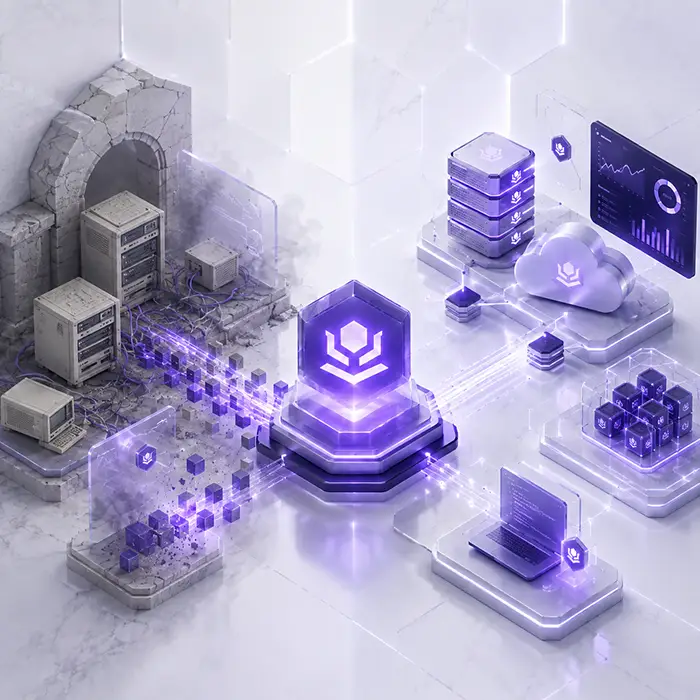
Illustrative modernization map comparing stabilization, modernization, transition, and rebuild paths
Transition architecture Stabilize · modernize · transition · rebuild

Modernization paths

The right path may be smaller — or more decisive — than a rewrite.

Modernization becomes practical when the available paths can be compared against the same operating and business constraints.

A system may need targeted stabilization, a supported runtime, modular extraction, progressive replacement, or a new application core. The sequence matters more than the label.

Stabilize

Protect the current system

Resolve support, deployment, security, observability, and testing risks that prevent safe operation.

Modernize

Renew the existing foundation

Update runtime, framework, dependencies, architecture, and interfaces while preserving the application core.

Transition

Replace capabilities progressively

Create boundaries that allow new services or modules to assume responsibility without one large cutover.

Rebuild

Create a new core

Re-express the recovered business model in a maintainable application designed for the company ahead.

Delivery

Turn modernization into a sequence the company can control.

The work separates understanding, immediate risk, future architecture, and migration so the company can make each commitment with better evidence.

  1. 01

    Recover

    Reconstruct the running system

    Map architecture, data, integrations, workflows, business rules, releases, and the knowledge held by current operators.

  2. 02

    Decide

    Choose the modernization path

    Compare stabilization, incremental modernization, progressive replacement, and rebuild against risk, cost, timing, and future value.

  3. 03

    Transition

    Build and migrate in controlled slices

    Introduce boundaries, move capabilities and data, validate behavior, and maintain coexistence where the business requires it.

  4. 04

    Continue

    Leave a maintainable operating system

    Complete documentation, release processes, observability, ownership, and the architectural basis for future development.

Communication

Modernization benefits from direct access to the people who know the current system. Most analysis and delivery can still remain asynchronous through code, diagrams, written decisions, and demonstrable transition progress.

Start with the system you have

Find the modernization path that protects today and unlocks tomorrow.

Share the application, stack, maintenance pressure, transition deadline, or rebuild proposal. Neoground can begin with the fixed assessment or shape a broader strategy and implementation engagement.